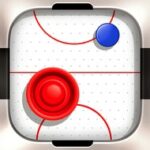
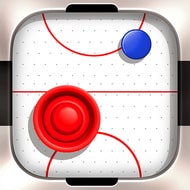
Air Hockey Championship Deluxe looks like the simplest game on this list — two mallets, one puck, a flat table — but it plays like a genuine test of reaction speed once the difficulty climbs past the early rounds. The rules never change, yet the margin for error keeps shrinking the longer a match runs.
| Genre |
Arcade sports simulation |
| Modes |
Single-player and two-player |
| Core Objects |
Mallet, puck, table, goal |
Mallet Control in Air Hockey Championship Deluxe
Everything about the game comes down to how you move your mallet relative to the puck’s trajectory. Sliding directly into a shot transfers speed unpredictably, while a controlled angled tap gives you far more say over where the puck ends up. New players tend to chase the puck across the whole table, which leaves their own goal wide open the moment possession flips.
The better habit, and one most competitive players adopt quickly, is staying centered near your own goal and only committing to an aggressive strike when the puck is fully in your control zone. This single adjustment cuts down on cheap goals conceded from panicked, off-angle mallet swings.
As difficulty increases across the game’s tiers, puck speed ramps up noticeably, and what worked as a defensive stance in the early matches starts feeling half a beat too slow. Players who rely purely on reflexes without adjusting positioning tend to plateau here.
Reading Rebounds Off the Table
Bank shots off the side rails are where Air Hockey Championship Deluxe separates casual players from people who’ve actually put in the hours. A puck bounced at the right angle off a rail can slip past a mallet that’s only guarding a straight line, and predicting rebound angles becomes a genuine skill the longer you play.
Two-player matches on the same device bring an entirely different rhythm than playing against the built-in difficulty tiers, since a human opponent adapts to your patterns in ways the standard AI simply doesn’t.
Frequently Asked
- Does mallet speed matter more than positioning? Positioning matters more overall — a well-positioned mallet can block or redirect a fast puck, while pure speed without proper angling just as often sends the puck straight into your own goal.
- Is the two-player mode noticeably different from playing solo? Yes, a second player introduces unpredictable shot patterns and feints that the single-player difficulty settings can’t fully replicate, which most players find considerably more engaging over time.
- Do bank shots off the rails actually work reliably? They do once you learn to read the puck’s incoming angle, since the rebound follows a fairly consistent reflection rule that becomes easier to predict with repeated play.
What keeps people coming back to Air Hockey Championship Deluxe isn’t complexity, it’s the tight feedback loop between mallet control and rebound prediction, and once bank shots off the rail start landing on purpose instead of by accident, the game stops feeling like reflexes and starts feeling like strategy.