You close the fridge, and the shelf is empty except for a single plate someone forgot to wash. That small detail is where Family Secrets 1: Empty Plate starts pulling the floor out from under you, turning what looks like a quiet babysitting night into something much harder to sit through.
| Genre |
First-person psychological horror |
| Platform |
PC |
| Playtime |
Roughly 30–40 minutes |
| Structure |
Short, linear, single house setting |
The Setup Inside Family Secrets 1: Empty Plate
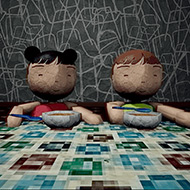
The game opens on Miko, a young teenager, taking a phone call from his mother. She tells him she has to leave for work for a few days, which means Miko is suddenly responsible for his younger sibling Jun, alone, in a house that starts to feel less normal with every room he checks. There’s no tutorial popup explaining a threat level, no health bar, no weapon to pick up. The game leans entirely on the discomfort of an ordinary domestic routine — checking on Jun, looking for something to eat, moving between rooms — slowly curdling into dread.
Players who go in expecting a jump-scare gallery tend to be thrown off by the pacing. Early sections of the game are almost mundane, and that’s deliberate. The tension is built out of small wrongness: a door that was open earlier and isn’t now, a room that felt safe an hour ago and doesn’t anymore. It’s the kind of design that rewards players who pay attention to environmental detail rather than players hunting for the next scripted jolt.
What separates Family Secrets 1: Empty Plate from a generic haunted-house game is how tightly it stays inside four walls. There’s no second location waiting behind a loading screen, no map to unlock. Everything a player needs to understand about Miko’s situation has to come from this one house, which puts a lot of weight on environmental storytelling rather than dialogue dumps.
Miko and Jun: Who You’re Actually Playing
Miko is the playable character throughout, and his relationship with Jun is the emotional spine of the whole game. He isn’t framed as a hero solving a mystery — he’s a kid handling a responsibility that’s clearly too big for him, and the writing leans into that discomfort rather than softening it. Jun, meanwhile, is largely reactive: a presence Miko has to check on, protect, and respond to as the house’s events escalate.
Speedrunners and completionist players approach this pairing very differently from players who came in for the story alone — the former tend to skip dialogue to shave time off the roughly 30-minute runtime, while narrative-focused players linger in rooms specifically to catch small details about Jun’s behavior that get easy to miss on a first pass.
One moment that gets brought up constantly in horror game communities is the hide-and-seek sequence, where the usual mechanics of the game briefly invert and Miko has to keep still rather than move. It’s a short beat, but it’s the one clip that circulated widely on TikTok and Twitch before most viewers had any context for the rest of the story.
Difficulty Curve and What Beginners Get Wrong
Because Family Secrets 1: Empty Plate has no combat, no upgrade system, and no score tracking, difficulty here isn’t mechanical — it’s about reading the house correctly. New players sometimes rush through rooms looking for an objective marker that never appears, which causes them to miss the small cues (a sound, an object out of place) that the game is actually built around.
By the time a player reaches the later stretch of the house, the claymation-style visuals that felt almost cozy at the start have been recontextualized. That shift is the game’s clearest structural choice, and it’s the reason a lot of first-time players say the ending lands harder than they expected from something with such a soft art style.
Frequently Asked Questions
How long does it take to finish Family Secrets 1: Empty Plate?
Most players finish it in a single sitting, with the official listing putting total playtime around 30 to 40 minutes depending on how much time is spent exploring rooms versus moving straight through required interactions.
Is there combat or a way to fail in Family Secrets 1: Empty Plate?
No — there’s no combat system, no weapons, and no traditional fail state built around enemies. Tension comes from environmental storytelling and specific scripted moments like the hide-and-seek sequence rather than a challenge system.
What does the title Empty Plate actually refer to?
The empty plate ties directly into the game’s focus on food, care, and neglect inside the house — it’s one of the first small domestic details the game uses to signal that something about Miko and Jun’s situation isn’t right.
Family Secrets 1: Empty Plate isn’t trying to be a long game, and it doesn’t need to be — its short runtime is exactly why the slow turn from domestic routine to something much darker still works. Anyone who sits with Miko through the hide-and-seek sequence and the quiet reveal near the end will understand why this small, four-walls story keeps getting brought up in horror game circles well past its release.