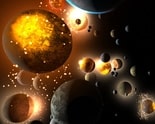
You open Universe Sandbox 2 to a fresh solar system, mass sliders and orbital paths laid out in front of you, and the first real lesson lands fast: nothing here is fixed unless you decide it should be. This is a physics-based space simulator where gravity, collisions, and orbital mechanics all run on real equations rather than scripted animations, which means every planet you nudge actually behaves like a planet, not a prop.
The Simulation Universe Sandbox 2 Is Actually Running
Underneath the polished visuals is a genuine N-body gravity simulation. Every object you place, planet, moon, star, stray asteroid, exerts real gravitational pull on everything else in the scene, and the orbits you see aren’t pre-baked, they’re calculated live from the masses and velocities involved.
- Real celestial bodies: Load the actual Sun, Earth, Mars, or Jupiter with their real measurements as a starting point.
- Adjustable properties: Mass, radius, spin, temperature, and orbit can all be changed on the fly.
- True physics: Gravity, tidal forces, and collisions are calculated rather than faked.
That accuracy is what separates it from a typical space game. Change Earth’s mass by a large enough margin and its moon’s orbit destabilizes exactly the way orbital mechanics says it should.
What Happens When You Smash Two Planets Together
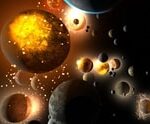
The collision system is where most first sessions end up eventually. Drag Mars into Earth’s orbit at the wrong angle and you’ll watch a genuinely modeled impact play out, debris fields, temperature spikes, orbital chaos rippling outward to every other body in the system.
Players newer to the game tend to treat this as a one-time spectacle, but veterans keep coming back to collision scenarios specifically to test edge cases, what mass ratio actually causes a moon to survive an impact instead of shattering, for instance, since the simulation answers that question honestly instead of hand-waving it.
Why Universe Sandbox 2 Quietly Dropped the “2” From Its Name
Here’s a detail that surprises even longtime players: the developers officially dropped the “2” from the title back in a 2020 update, rebranding it simply as Universe Sandbox, even though the older name still circulates constantly in casual conversation and search habits. It wasn’t a sequel in the traditional sense to begin with, more a continuously updated evolution of the same simulation core.
That naming quirk causes real confusion for newcomers trying to figure out if they’re buying an old version or the current one. In practice, the simulation has simply kept growing under a simplified name.
Where Beginners Waste Time Fighting the Physics
New players often try to force stable orbits by eye, nudging velocity vectors slightly and hoping gravity cooperates. The game rewards a more deliberate approach instead, using the built-in orbit tools to set a circular or elliptical path directly rather than guessing at values through trial and error.
The second common mistake is scaling time up too aggressively before a system has settled. Watching a freshly built system unfold at a slower time scale first reveals instabilities that would otherwise cause a confusing collapse hours later at high speed.
Advanced Moves: Scripting, VR, and Building Real Systems
Experienced users push past the sliders into Lua-based scripting to automate complex scenarios, building custom events that trigger based on in-simulation conditions rather than manual input. The game’s VR support adds another layer entirely, letting you physically reach into a solar system and reposition planets by hand.
- Do I need to understand real physics to enjoy Universe Sandbox 2? No, but the simulation rewards curiosity. Testing a guess about gravity or collisions and watching it play out accurately is much of the appeal even without a physics background.
- Can I recreate our actual solar system exactly? Yes, real measurements for known planets, moons, and the Sun are built in as a starting template. From there you’re free to modify anything, from Jupiter’s mass to Earth’s orbital distance.
Whatever you came to Universe Sandbox 2 to do, blow up a planet, build a stable multi-star system, or just watch the Moon slowly drift away from Earth over simulated centuries, the appeal never really comes from a scripted goal. It comes from a simulation honest enough to show you exactly what your choices actually do.