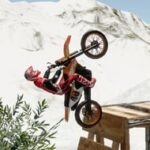
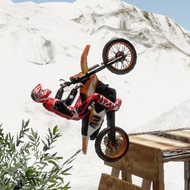
In Bike Trials Winter 1 you start each course with a choice between a motorbike and an ATV, and that choice matters more than it first appears. The snow-covered terrain punishes momentum mistakes differently depending on which vehicle you’re riding, and picking the wrong one for a given track can turn a manageable run into a string of restarts.
| Genre |
Physics-based trials racing |
| Setting |
Snow-covered mountain tracks |
| Vehicles |
Motorbike or ATV |
| Objective |
Reach the finish flag while avoiding crashes |
Balance and Momentum in Bike Trials Winter 1
The core of the game is simple to state and difficult to master: lean your rider forward or back to keep the bike balanced across uneven, icy terrain, and manage throttle carefully enough that you don’t send your rider flying over the handlebars. Every track is a sequence of ramps, drops, and narrow ledges, and the physics engine does not forgive careless acceleration on a downhill slope.
Beginners almost always over-commit on jumps. It’s tempting to gun the throttle heading into a ramp, but landing at the wrong angle on packed snow sends the bike skidding sideways, and a hard enough impact ends the run on the spot. Learning to ease off just before a jump and let the bike’s own momentum carry it is the single biggest improvement most new players can make.
By the time you reach the steeper mountain sections later in the run, the margin for error narrows considerably. Icy patches reduce traction unpredictably, and a wheelie held a fraction too long on a slope that suddenly drops away is one of the more common ways players lose a run they thought was going well.
Stunts and Scoring on the Mountain
Pulling off stunts in mid-air isn’t just for show in Bike Trials Winter 1 — flips and wheelies performed cleanly translate directly into extra earnings you can spend on new bikes and gear. Players who treat every jump as a scoring opportunity tend to progress through the vehicle roster faster than those who play purely for survival.
- Front flips off larger ramps for higher stunt payouts
- Wheelie holds through flatter stretches between obstacles
- Clean landings that avoid a faceplant penalty
One thing longtime players bring up constantly is how differently the ATV handles compared to the motorbike on icy inclines — the extra stability comes at the cost of tighter turning, which becomes a real handicap on tracks with narrow switchbacks.
What Divides the Player Base
A common complaint centers on how unforgiving the restart system feels on longer tracks. Some players appreciate that a single mistake near the end forces a full retry, since it keeps every attempt tense from start to finish. Others feel the lack of mid-course checkpoints on certain tracks turns minor errors into disproportionate punishment.
Speedrun-focused players memorize a track’s terrain shifts and plan throttle inputs almost frame by frame, while more casual players lean on trial and error, restarting freely until a route feels natural. Both groups tend to agree that the game’s snow physics reward patience over aggression, even if they disagree on how strict that punishment should be.
Frequently Asked
Is the ATV easier to control than the motorbike on icy tracks?
The ATV generally offers more stability on straight, icy stretches thanks to its wider wheelbase, but it turns less sharply, which makes it a weaker pick on tracks with tight switchbacks near the finish flag.
What causes most crashes in the early tracks?
Most early crashes come from over-accelerating into a jump rather than from the terrain itself — easing off the throttle just before a ramp and trusting existing momentum solves the majority of early faceplants.
Do stunts actually affect progression, or are they just cosmetic?
Stunts performed cleanly add directly to your earnings, which you then spend on unlocking new bikes, so treating jumps as scoring chances rather than just obstacles to clear meaningfully speeds up progression.
Bike Trials Winter 1 rewards the kind of patience that doesn’t come naturally on a first run, and once you’ve learned to read a slope before committing your throttle, even the trickiest icy switchback starts to feel less like luck and more like a skill you’ve actually earned.