Weekly Picks

Avatar World

Love Tester

Avatar World 2

Avatar World 2025

Shoujo City

SAKURA School Simulator

Avatar World Update

Yandere Simulator

Avatar World: City Life


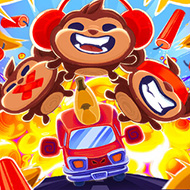
BOMBANANA! looks like a goofy party game about three cartoon monkeys and a ticking bomb, but it plays like a communication stress test that punishes assumptions faster than it punishes wrong wire cuts.
The premise is deliberately unfair. One player is the Blind Monkey, the only one allowed to physically touch the bomb, but they see nothing but silhouettes and have to read the bomb’s Braille panels entirely by feel. Another is the Deaf Monkey, who can see the bomb and any manual pages clearly but can’t hear a single word their teammates say. The third is the Mute Monkey, who can see and hear everything but can’t speak, so their entire contribution has to travel through gestures, drawings, or whatever workaround the group invents on the spot.
No player has the full picture, and the game never hands you one either. Voice chat is restricted by role, so the Deaf Monkey’s screen genuinely goes silent regardless of what’s happening around them, and that restriction is enforced at the engine level, not just roleplayed.
Unlike most co-op puzzle games, BOMBANANA! has a hard requirement: it will not start with two players, and there’s no solo mode at all. The entire design assumes three distinct information gaps working against each other, and removing one role collapses the puzzle instead of simplifying it. This is one of the more common points of confusion for players coming in expecting a flexible party game rather than a fixed three-person format.
Each bomb is built from Puzzle Modules, and every module comes with different rules and a different flavor of panic. The game never tells you how to communicate a wire color or a symbol to your teammates — building that shared vocabulary is entirely on the group, which is why two different squads can solve the same module in completely different ways. Some invent tapping codes for the Deaf Monkey, others rely on the Mute Monkey drawing shapes in the air.
This open-ended approach to communication is what the community tends to praise most, though it’s also a source of friction the developers themselves acknowledge — early sessions with strangers can turn into shouting matches before anyone lands on a working system, and that chaos is treated as a feature rather than a bug players should expect polish to remove.
Once a group has cleared enough of the level system, Free Mode opens up, letting players design their own bomb layouts instead of working through the preset progression. It’s less about difficulty and more about testing how much trust and shorthand the group has actually built up over repeated sessions, and it’s become a popular way for established trios to keep playing after finishing the main level track.
Early in a session, most groups fumble the simplest instructions purely because nobody has agreed on terminology yet — someone says “left” and means their own left, not the Blind Monkey’s. By the time a group reaches their fifth or sixth bomb, that same instruction gets resolved in seconds, and the difference is entirely attributable to whatever shorthand the three of you built together rather than anything the game explicitly teaches. That gap between a shaky first bomb and a smooth later one is the specific feeling players describe when they say the game rewards playing with the same two people repeatedly.
The demo currently supports three-player sessions on Windows and macOS, with the full release targeting an August 2026 window, and the current wishlist and demo numbers suggest the asymmetric-communication hook is landing with a wider audience than a typical party puzzle title.
No. The game requires exactly three players to start a session — the Blind, Deaf, and Mute Monkey roles are all mandatory, and there is no solo or two-player mode built into the current release.
Voice chat is restricted according to each monkey’s missing sense, so the Deaf Monkey genuinely doesn’t hear teammates speaking, which forces the group to invent non-verbal signals rather than relying on straightforward callouts.
Free Mode lets a group design their own bomb rather than progressing through the preset level system, and it’s mainly used by trios who’ve already cleared the main content and want to keep testing their communication system.
Whether it’s the Blind Monkey fumbling toward a Braille panel on nothing but a teammate’s shaky directions or a Free Mode bomb built specifically to break your group’s usual shorthand, BOMBANANA! keeps coming back to the same idea: the bomb was never really the hard part.