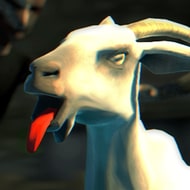
What happens when you attach your tongue to a rolling barrel and fling it downhill into a crowd of the undead? In Goat vs Zombies, that’s not a rhetorical question — it’s a genuine strategy, and figuring out which objects launch the farthest is half the appeal of the game.
| Genre |
Physics-based destruction sandbox |
| Playable Character |
A goat with tongue-grab abilities |
| Maps |
2 explorable levels packed with secrets |
| Core Threat |
Zombie hordes across both maps |
The Tongue Mechanic That Defines Goat vs Zombies
Everything unusual about this game traces back to one ability: your goat can latch its tongue onto almost any object in the environment. Cars, barrels, explosives, even zombies themselves can be grabbed, dragged, and launched, and the game leans hard into the chaos that creates rather than trying to contain it.
New players usually underestimate how much the tongue can do. It’s tempting to treat headbutting as the primary way to deal with zombies, and while ramming works fine early on, the tongue is what unlocks the game’s more absurd moments — like dragging a car up the slide and launching it downhill into a cluster of enemies for a satisfying chain reaction.
Once you’ve explored a map for a while, the difficulty shifts from “how do I deal with zombies” to “how much destruction can I cause before running out of time.” The game doesn’t really punish failure in a traditional sense; it rewards creativity and experimentation, which changes what “getting better” even means here compared to a typical action game.
The Slide and Zombie Superbowl
One of the standout mechanics players bring up constantly is the bowling slide — drag any object up with your tongue and give it a push to send it rocketing down into a group of zombies. Landing a big multi-hit chain this way is one of those moments that feels distinctly like this game and nothing else in the genre.
Explosives add another layer entirely. Detonating a bomb near a cluster of zombies sends bodies flying in ways that feel deliberately over the top, and it’s clearly part of the game’s sense of humor rather than an oversight.
Exploring the Maps and Finding Secrets
Both maps hide secret objects and interactions that aren’t signposted anywhere in the game. Players comb through corners of each map specifically hunting for these, and the community generally treats full exploration as its own goal separate from just causing mayhem.
- Hidden objects tucked into corners of both maps
- Secret achievements tied to specific, undocumented actions
- Bonus time pickups that extend how long you can keep playing a level
A completionist player will comb every inch of both maps hunting for these secrets before touching the roller coaster even once. A more chaos-focused player skips straight to the explosives and the slide, treating secrets as a bonus rather than a goal. Either way, the killer train roaming the map is something every player eventually has to account for, since it adds an unpredictable hazard even during otherwise calm exploration.
Honest Criticism From Players
The most common complaint in player reviews is the lack of a free-play mode without a timer. Timed levels work fine for chasing scores, but players who just want to mess around with the tongue mechanic and explosives without pressure often find the time limit gets in the way of the sandbox fantasy the game is otherwise selling.
Questions Players Ask Before Playing
How many levels does Goat vs Zombies actually have?
The game currently ships with 2 full maps, each dense enough with secrets and destructible objects that most players spend considerably longer per map than the level count alone would suggest.
Can you use the tongue on zombies directly, not just objects?
Yes — grabbing zombies with the tongue and flinging them into other zombies or off the map is one of the more reliable ways to rack up chain destruction quickly.
Is there a way to extend the time limit on a level?
Collecting bonus time pickups scattered around each map extends your run, which is currently the main way to offset the timer without a dedicated free-play mode.
Between the tongue-grab launches, the roller coaster, and the ever-present threat of the killer train, Goat vs Zombies earns its chaotic reputation honestly, and the game rewards exactly the kind of experimentation most sandbox destruction fans are looking for.