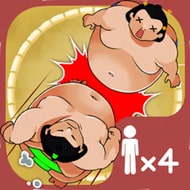
You shove your mallet-armed opponent toward the edge of the ring, misjudge the recoil, and watch your own character stumble backward off the platform instead. That reversal is the entire personality of Sumo Party — a game where committing too hard to an attack is often more dangerous than not attacking at all.
| Genre |
Local multiplayer arena battler |
| Players |
Up to four on a single device |
| Objective |
Push opponents off the ring |
| Match Format |
Best of a short set of rounds |
The Push Mechanic at the Core of Sumo Party
Every character in the ring shares the same basic toolkit: hold to charge a push, release to unleash it, and hope the timing lines up before your opponent does the same to you. It sounds straightforward until you realize that overcommitting to a charge leaves you exposed for a fraction of a second longer than feels safe.
New players tend to charge their push for as long as possible, assuming more charge always means more force. In practice, a fully charged push takes long enough to wind up that a quicker opponent can sidestep and counter before it ever lands, which is exactly the kind of lesson the ring teaches the hard way.
Once you’ve played enough rounds, positioning near the edge starts to feel less like recklessness and more like bait — an experienced player will deliberately stand close to the boundary to bait an opponent into an overcommitted charge, then dodge and let momentum do the rest.
Reading Opponents in the Ring
With four players sharing a small ring, the game shifts fast between one-on-one duels and chaotic free-for-alls where getting caught between two charging opponents at once ends your round instantly. Watching stance and charge animations becomes second nature after a handful of matches.
- A crouched stance usually signals an incoming charge
- Standing near the edge invites a bait-and-dodge counter
- Grouping near the center increases the risk of a multi-push chain
Players who favor pure aggression tend to win fast, decisive rounds but lose badly against anyone patient enough to wait out a wasted charge. Meanwhile players who play defensively for too long often get caught out once the ring’s boundaries close in during later rounds of a set, which is a detail the game rarely explains outright.
What Players Debate About Sumo Party
One frequent point of disagreement is how much four-player chaos actually rewards skill versus luck. In a tight one-on-one, timing and positioning clearly decide the round. Once four characters are pushing and dodging simultaneously, a lot of eliminations come down to who happened to be standing in the wrong spot rather than a read anyone genuinely made.
What happens if two players push each other at the exact same moment is a question that comes up constantly among newer players — generally, whichever charge was released a fraction of a second earlier wins out, though on a near-simultaneous release both players can end up stumbling backward with neither losing the round outright.
Sumo Party earns its chaotic reputation honestly, and the tension between committing to a full charge and getting baited into one is what keeps even a simple push mechanic feeling sharp match after match in the ring.