Weekly Picks

Avatar World

Love Tester

Avatar World 2

Avatar World 2025

Shoujo City

SAKURA School Simulator

Avatar World Update

Yandere Simulator

Avatar World: City Life


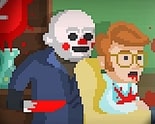
It looks like a Saturday-morning cartoon, all rounded edges and bright colors, but it plays like an ’80s slasher film that skipped the content warnings entirely. That’s the whole trick behind The Happyhills Homicide, a stealth-and-puzzle horror game where you step into a killer’s mask and start working through a very personal list of targets in a town that thought its worst days were behind it.
| Genre | Cartoon Slasher / Stealth-Puzzle Horror |
| Platform | PC (Steam, GameJolt) |
| Release | 2020 (GameJolt), 2024 (Steam) |
| Levels | 20 |
The mask comes first: a wide, clownish grin painted over featureless white, the kind of design that would fit comfortably in a kids’ cartoon if it weren’t attached to someone hunting people down level by level. Pale Grin doesn’t announce himself with a monologue, he just shows up. The gap between his cartoonish silhouette and what he’s actually there to do is where most of the game’s dark comedy lives.
Every level hands you a specific tool or method suited to that level’s environment. Figuring out how to use it without getting spotted is the entire puzzle layer sitting underneath the horror presentation.
Pale Grin isn’t a supernatural force, he’s John Wade, a former janitor with a very specific grudge against a very specific list of people. The game reveals this gradually rather than upfront, and knowing it changes how you read every level, this isn’t random violence, it’s methodical payback dressed up in cartoon colors.
That grounding is part of why The Happyhills Homicide gets brought up in slasher-game discussions more than generic horror titles do. Wade’s motivation reframes each target as a chapter in a specific grudge rather than an anonymous kill count.
Most of Wade’s targets trace back to Westpine High, where he worked as a janitor and, by the game’s implication, endured years of being bullied and dismissed by students who never expected consequences. That backstory does a lot of quiet work, it turns levels that could feel like arbitrary horror setpieces into something closer to a settling of very specific, very old scores.
Players who pay attention to environmental details, yearbooks, lockers, overheard dialogue between NPCs, tend to piece together which target did what to Wade long before the game states it outright. That kind of environmental storytelling is something the fanbase actively hunts for on repeat playthroughs.
The game doesn’t stay locked to Wade’s perspective the whole time. Certain levels flip control to Bryan Pawalski, a detective with the Happyhills Police Department piecing together the murders from the outside, and these sections play more like investigation puzzles than stealth-kill sequences.
The tonal whiplash between playing the killer and playing the investigator chasing him is deliberate, and it’s one of the more distinctive structural choices in the whole game. Few horror titles let you occupy both sides of the same case within a single playthrough.
The moment-to-moment loop breaks down into a few repeating pieces:
New players tend to rush the scouting phase, assuming the game wants immediate action the way a typical slasher game might. In fact, patience during the setup is what makes the actual moment land cleanly.
The most common beginner mistake is treating every level’s tool as interchangeable, when the game is actually built around each one having a specific window of opportunity tied to the environment. Trying to force a method the level wasn’t built for usually ends in a witness spotting you, and Happyhills’ witness system is unforgiving once someone starts moving toward an exit or a phone.
The second mistake is ignoring ambient sound cues, footsteps, doors, background chatter, which are the game’s main warning system for approaching NPCs. Players who play with sound off consistently report a much rougher time than players who don’t.
Almost every target on Wade’s list connects back to his time at Westpine High in some way, which makes Madison stand out. She’s the one named victim who wasn’t part of the bullying that drives the rest of the story, and her inclusion on the list is one of the more debated plot threads among players trying to map Wade’s full logic.
Whether that inconsistency is intentional, a hint that Wade’s judgment has slipped past reasonable grievance into something less controlled, or simply an open thread the sequel picks up, nobody has settled it definitively. It’s exactly the kind of loose end that fuels long theory threads after a full playthrough.
Players chasing a clean, no-witness clear on every level tend to memorize patrol timing to the second rather than reacting in the moment, treating each level almost like a rhythm puzzle disguised as stealth horror. Completionists going for every level’s best rating also learn to bait NPCs into specific positions rather than waiting passively for them to wander into range.
Speedrunning circles around this game favor a different approach entirely, skipping full scouting in favor of known kill routes memorized from repeat attempts. That trades the tension of a first-time approach for raw execution speed.
It’s worth being upfront that the collision of cartoon art and genuinely graphic kills isn’t for everyone, and that’s by design rather than an oversight. Some players find the contrast is what makes the horror land, since the friendly art style lowers your guard right before something brutal happens. Others find the same contrast tonally confusing, unsure whether the game wants to be taken seriously or played for dark laughs.
That tension between comedy and horror never fully resolves. Honestly, the game seems to know it, since even its own detective subplot plays its investigation scenes with a straighter face than Wade’s murder levels ever do.
Whether you clear every level of The Happyhills Homicide chasing a perfect stealth rating or barrel through it for the dark comedy of watching a cartoon janitor settle old scores, the game’s real hook is how uncomfortable it makes rooting for either John Wade or Bryan Pawalski feel by the end. Few slasher games manage to make you question who you’re actually supposed to be cheering for.